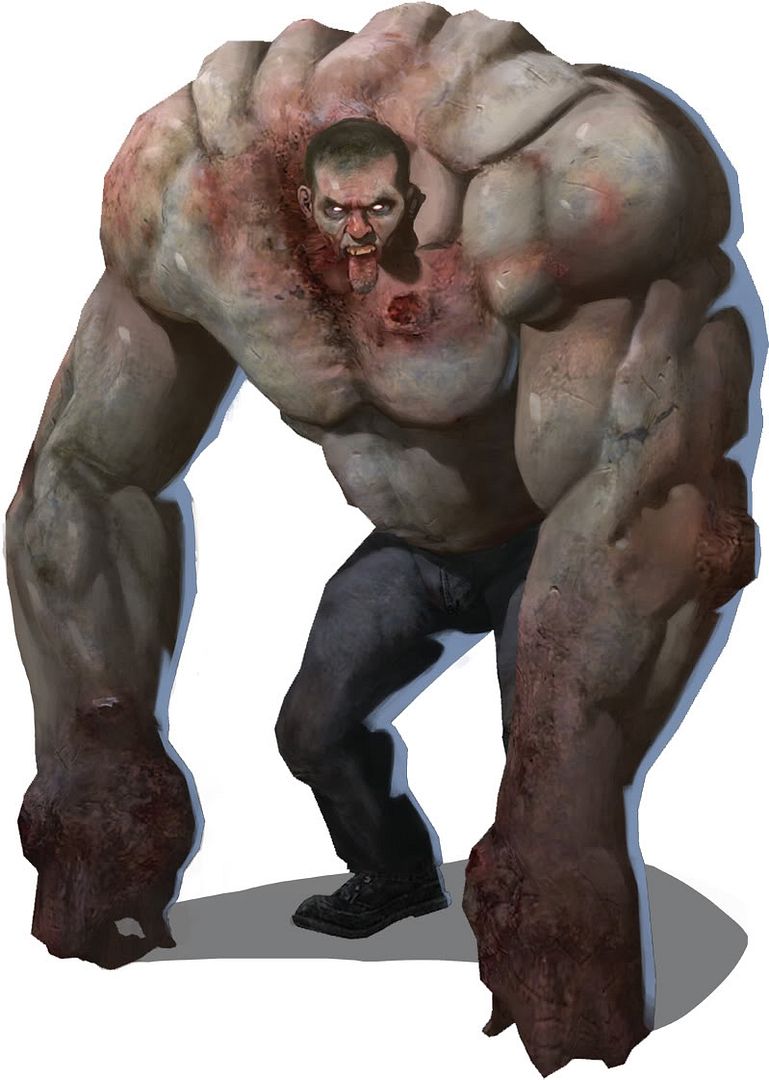
One of the reasons I expect Borderlands to be a lot of fun is the dynamic comments that give individual enemies personalities:
The amusing outbursts of enemies makes them more than just faceless meatbags. The Halo series has proven how effective this can be.
Giving enemies dynamic outbursts does two things. First, it adds a personal dimension to combat, making it feel like your actually fighting individuals and not the Borg. Second, it adds variation and replay value. It can make one enemy feel slightly different from another despite both using the same model and the same AI.
This isn't only possible with human enemies. Individual dogs of the same breed can have different barks. Individual skaags or other beasts could have different growls, screeches, etc. Voice variation with animals and monsters has an effect similar to that with humans.
Nor does personalizing individual enemies have to be done only through modeling, AI, and voicing. There's also animations. Slightly different hand motions, ways of walking, relaxed and defensive stances, and so on can make enemies which are otherwise the same feel like true individuals.
Every aspect of NPCs changes the experience.
Showing posts with label variation. Show all posts
Showing posts with label variation. Show all posts
Thursday, October 15, 2009

Friday, July 10, 2009
empty space
Take a minute to look at this picture:

Such an impressive image, yet so empty.
Empty is good sometimes. Space without objects isn't always wasted space.

Such an impressive image, yet so empty.
Empty is good sometimes. Space without objects isn't always wasted space.
Wednesday, May 27, 2009
replay systems
I recently joined GameDev.net. Lots of good discussion there and good resources for new developers. The following's a carryover of my comments there.
Recordings of player moments (screenshots, video clips, etc) are great both in terms of player enjoyment and marketing. But a distinction should be made between planned and unplanned clips.
On the one hand, you have player-scripted events; machinima. Spore and The Sims 2 offer players in-game tools for this. Alternatively, World of Warcraft is commonly used but through external tools not provided by Blizzard. Such recordings are popular, but the planning and interface know-how required limits their user appeal.
On the other hand are unexpected events which the player discovers and wants to memorialize. Replay systems are more rare, but also, I think, more valuable. NCAA Football '08, for example, automatically records every play and allows players to select from those recordings events for permanent memory. That means that if something unintentional or unexpected excites the player, it can be recorded after-the-fact. The game also allows the player to view the event from different angles. Similar systems allowing cropping and editing, but the simplest systems have the broadest appeal.
Of the two kinds of recordings, planned and revisited, the latter appeals to more gamers. It is more useful for marketing as well, since the recorded events represent actual, unscripted gameplay which any player might hope for.
I wonder if there might also be occasional value in audio recordings. At this time, apart from music, audio in games is rarely worthy of memory. Undoubtedly, some game enthusiasts have favorite lines of dialog and such which they would happily preserve, but game audio is not dynamic enough to offer individual experiences -- the primary basis of personal recordings. How to make it so is worth consideration.
Recordings of player moments (screenshots, video clips, etc) are great both in terms of player enjoyment and marketing. But a distinction should be made between planned and unplanned clips.
On the one hand, you have player-scripted events; machinima. Spore and The Sims 2 offer players in-game tools for this. Alternatively, World of Warcraft is commonly used but through external tools not provided by Blizzard. Such recordings are popular, but the planning and interface know-how required limits their user appeal.
On the other hand are unexpected events which the player discovers and wants to memorialize. Replay systems are more rare, but also, I think, more valuable. NCAA Football '08, for example, automatically records every play and allows players to select from those recordings events for permanent memory. That means that if something unintentional or unexpected excites the player, it can be recorded after-the-fact. The game also allows the player to view the event from different angles. Similar systems allowing cropping and editing, but the simplest systems have the broadest appeal.
Of the two kinds of recordings, planned and revisited, the latter appeals to more gamers. It is more useful for marketing as well, since the recorded events represent actual, unscripted gameplay which any player might hope for.
I wonder if there might also be occasional value in audio recordings. At this time, apart from music, audio in games is rarely worthy of memory. Undoubtedly, some game enthusiasts have favorite lines of dialog and such which they would happily preserve, but game audio is not dynamic enough to offer individual experiences -- the primary basis of personal recordings. How to make it so is worth consideration.
Tuesday, April 28, 2009
player dynamics vs scenario dynamics
After reading GameInformer's preview of Assassin's Creed 2 and other tidbits, I'm excited about the game. The first game provided gameplay that was excellent but redundant. Ubisoft seems to be tackling the redundancy problem.
That said, I hope they don't focus on player dynamics to the exclusion of scenario dynamics. Player dynamics are the various methods of interaction offered to the player. Scenario dynamics are variations in all that exists with or without the player, like the setting and fixed events. One sort of dynamics is initiated by the player, the other by the gameworld.
In my gaming experience, the latter is more vital. Both should be present, but gameplay is better refreshed by environmental dynamics.
Bioshock offers players many choices in character development, weapons and strategy. But how eager were you to watch the same cutscenes, hear the same dialog, follow the same path, encounter the same enemies, etc? Scenario dynamics certainly existed, but player dynamics clearly received much more emphasis.
Oblivion is another example. Though the game had perhaps the best terrain variety ever, and dynamic weather to boot, too many things were static and predictable: enemy types and behaviors, NPC dialog, quests, gear, etc. I could approach the same adventure in a different way, but that's a mediocre, half-hearted thrill.
Scenario dynamics can include neutral factions/characters/beasts (will attack anything, the player or the player's enemies), visual events (like a flock a birds flying by or a piece of driftwood moving along a shoreline), variation in enemy AI, dialog variation, and gear variation. This is the adventure aspect, the unpredictable elements which the player must respond to.
It's not enough for a dynamic to create a new experience. It must be a meaningful and memorable experience. Wood that splinters under pressure from the player's bullets, for example, is a dynamic, but not necessarily a meaningful dynamic. A few crates falling apart or boards snapping in two as the player trades bullets with one enemy probably isn't going to leave a big impression. However, a huge battle with many enemies all around and splinters flying everywhere might be a fight to remember. If the player is able to shoot some support beams to drop enemies from a collapsing balcony, that's even better.
Anyway, I'm just saying, don't forget the environment and events out of the player's control when you're looking for possible dynamics to include. The unpredictable is usually more affective than the predictable.
Let me repeat an old point: replayability is what prevents gamers from trading in their games and forcing you to compete with used copies. And it increases value for gamers, because our games have lasting value. It's nice when we can revisit old games the same way we revisit old movies on DVD.
The games that earn my loyalty to a series or brand are the games that last for months.
That said, I hope they don't focus on player dynamics to the exclusion of scenario dynamics. Player dynamics are the various methods of interaction offered to the player. Scenario dynamics are variations in all that exists with or without the player, like the setting and fixed events. One sort of dynamics is initiated by the player, the other by the gameworld.
In my gaming experience, the latter is more vital. Both should be present, but gameplay is better refreshed by environmental dynamics.
Bioshock offers players many choices in character development, weapons and strategy. But how eager were you to watch the same cutscenes, hear the same dialog, follow the same path, encounter the same enemies, etc? Scenario dynamics certainly existed, but player dynamics clearly received much more emphasis.
Oblivion is another example. Though the game had perhaps the best terrain variety ever, and dynamic weather to boot, too many things were static and predictable: enemy types and behaviors, NPC dialog, quests, gear, etc. I could approach the same adventure in a different way, but that's a mediocre, half-hearted thrill.
Scenario dynamics can include neutral factions/characters/beasts (will attack anything, the player or the player's enemies), visual events (like a flock a birds flying by or a piece of driftwood moving along a shoreline), variation in enemy AI, dialog variation, and gear variation. This is the adventure aspect, the unpredictable elements which the player must respond to.
It's not enough for a dynamic to create a new experience. It must be a meaningful and memorable experience. Wood that splinters under pressure from the player's bullets, for example, is a dynamic, but not necessarily a meaningful dynamic. A few crates falling apart or boards snapping in two as the player trades bullets with one enemy probably isn't going to leave a big impression. However, a huge battle with many enemies all around and splinters flying everywhere might be a fight to remember. If the player is able to shoot some support beams to drop enemies from a collapsing balcony, that's even better.
Anyway, I'm just saying, don't forget the environment and events out of the player's control when you're looking for possible dynamics to include. The unpredictable is usually more affective than the predictable.
Let me repeat an old point: replayability is what prevents gamers from trading in their games and forcing you to compete with used copies. And it increases value for gamers, because our games have lasting value. It's nice when we can revisit old games the same way we revisit old movies on DVD.
The games that earn my loyalty to a series or brand are the games that last for months.
Tuesday, March 31, 2009
what RPGs could learn from CoD4
One of Call of Duty 4's best features is its encouragement of variation through the Barracks and experience points. You can rank up without ever using more than one weapon, but there are bonuses to be had in trying many weapons. I'm not usually an achievement-oriented gamer, but I try to get every accomplishment with every weapon in that game.
The most experimentation a typical RPG encourages is swapping between melee and ranged attacks. But they could use a model similar to CoD4's. Instead of making every weapon a separate skill path, you could just have weapon upgrades be unlocked through use and encourage (without demanding) the player to try something new from time to time.
That applies to single-player as well as multiplayer. But, now that I think about it, I'm surprised I've never seen a fantasy battleground game (ala LOTR: Conquest) with weapon and skill variety similar to Call of Duty 4. Instead of ammo, melee weapons could have durability stats and eventually break... forcing the player to either switch weapons or pick up whatever's lying on the ground where another player fell. It doesn't take much imagination to see how CoD4's multiplayer could be adapted to many settings and scenarios.
In any case, my point is that RPGs shouldn't always expect players to stick with a single weapon class. It's feasible for all skills (like Perks) to be gear-agnostic. The same player may prefer different weapons and gear for different scenarios. And, of course, variation can keep gameplay fresh and enjoyable.
The most experimentation a typical RPG encourages is swapping between melee and ranged attacks. But they could use a model similar to CoD4's. Instead of making every weapon a separate skill path, you could just have weapon upgrades be unlocked through use and encourage (without demanding) the player to try something new from time to time.
That applies to single-player as well as multiplayer. But, now that I think about it, I'm surprised I've never seen a fantasy battleground game (ala LOTR: Conquest) with weapon and skill variety similar to Call of Duty 4. Instead of ammo, melee weapons could have durability stats and eventually break... forcing the player to either switch weapons or pick up whatever's lying on the ground where another player fell. It doesn't take much imagination to see how CoD4's multiplayer could be adapted to many settings and scenarios.
In any case, my point is that RPGs shouldn't always expect players to stick with a single weapon class. It's feasible for all skills (like Perks) to be gear-agnostic. The same player may prefer different weapons and gear for different scenarios. And, of course, variation can keep gameplay fresh and enjoyable.
Thursday, November 13, 2008
Left 4 Dead demo
I tried the Left 4 Dead demo on my Xbox 360 last night. Wow! This game rocks.
Many features make it great, but none so much as the unpredictability introduced by the dynamic spawning. Brian and I played the demo for an hour or two last night, and every playthrough felt fresh... despite the environment and goal being exactly the same each time. You never know when or where the next attack will come, how many zombies will come at you, or what types of monsters may join them.
Once, we all died and so started back at the safe point. When we got to the area where before we had been overwhelmed with a huge horde of zombies, this time that area was completely barren. It was eerie. I remember Brian saying, "I've got a bad feeling about this". The areas just beyond were also empty. Then, of course, we got smacked by a couple dozen zombies.
Where you are when particularly nasty strikes come and what condition your team is in from previous fighting can make all the difference in the world. How many directions can enemies come from? Zombies can come from directions you just cleared (which the environment design makes believable, by the way).
Is there a defensible position (like a corner, in a train, or on top of a car) nearby? At one point, we were progressing through a subway train when a Tank appeared outside. When the Tank repeatedly slammed against the side of the train, leaped on and off the roof, I was certain he was too big to get inside. I was wrong. And yes, we all died.
Even reloading is a powerful dynamic in this game. In most FPS games, like Halo, enemies move slowly enough and there are few enough of them that you can run and dodge while reloading to avoid damage. In Left 4 Dead, enemies are quick and they often come in hordes. At exactly what moment you must reload your shotgun or assault rife is sometimes the difference between life and death.
The game adapts to how well or poorly you're doing. Sometimes you'll find extra weapons, ammo, health packs and pain pills. Other times, you'll be sorely disappointed. You can select a degree of difficulty at the beginning, but the game adjusts dynamically within that selected difficulty range.
Brian and I spent the majority of our time trying the demo on Expert difficulty. I don't know how many times we tried to beat that level, but we never reached the safe point (the level's end). On the last try, I was almost within sight of the end. I was the last survivor. All I had to do was run up a small flight of stairs and sprint a short distance to the safe room. But when I entered the stairwell, lo and behold, there was a Hunter waiting for me on the steps. I got a couple shots off before it lunged, but not enough to stop it from making a meal of me. Such is Left 4 Dead.
And that's just the demo: 2 levels and one multiplayer mode. I haven't tried Versus mode, but it sounds great. The full game includes 4-player co-op, 8-player online battles, split-screen, and 20 maps.
Dynamics, dynamics, dynamics. The variety and unpredictability is the most important aspect of this game. Left 4 Dead has quickly moved to the top of my must-buy list.
Many features make it great, but none so much as the unpredictability introduced by the dynamic spawning. Brian and I played the demo for an hour or two last night, and every playthrough felt fresh... despite the environment and goal being exactly the same each time. You never know when or where the next attack will come, how many zombies will come at you, or what types of monsters may join them.
Once, we all died and so started back at the safe point. When we got to the area where before we had been overwhelmed with a huge horde of zombies, this time that area was completely barren. It was eerie. I remember Brian saying, "I've got a bad feeling about this". The areas just beyond were also empty. Then, of course, we got smacked by a couple dozen zombies.
Where you are when particularly nasty strikes come and what condition your team is in from previous fighting can make all the difference in the world. How many directions can enemies come from? Zombies can come from directions you just cleared (which the environment design makes believable, by the way).
Is there a defensible position (like a corner, in a train, or on top of a car) nearby? At one point, we were progressing through a subway train when a Tank appeared outside. When the Tank repeatedly slammed against the side of the train, leaped on and off the roof, I was certain he was too big to get inside. I was wrong. And yes, we all died.
Even reloading is a powerful dynamic in this game. In most FPS games, like Halo, enemies move slowly enough and there are few enough of them that you can run and dodge while reloading to avoid damage. In Left 4 Dead, enemies are quick and they often come in hordes. At exactly what moment you must reload your shotgun or assault rife is sometimes the difference between life and death.
The game adapts to how well or poorly you're doing. Sometimes you'll find extra weapons, ammo, health packs and pain pills. Other times, you'll be sorely disappointed. You can select a degree of difficulty at the beginning, but the game adjusts dynamically within that selected difficulty range.
Brian and I spent the majority of our time trying the demo on Expert difficulty. I don't know how many times we tried to beat that level, but we never reached the safe point (the level's end). On the last try, I was almost within sight of the end. I was the last survivor. All I had to do was run up a small flight of stairs and sprint a short distance to the safe room. But when I entered the stairwell, lo and behold, there was a Hunter waiting for me on the steps. I got a couple shots off before it lunged, but not enough to stop it from making a meal of me. Such is Left 4 Dead.
And that's just the demo: 2 levels and one multiplayer mode. I haven't tried Versus mode, but it sounds great. The full game includes 4-player co-op, 8-player online battles, split-screen, and 20 maps.
Dynamics, dynamics, dynamics. The variety and unpredictability is the most important aspect of this game. Left 4 Dead has quickly moved to the top of my must-buy list.
Saturday, July 12, 2008
classes vs roles (response to Warhammer news)
If you're interested in Warhammer Online at all, you've probably read about Mythic's decision to drop four classes before their imminent launch. I respect that they're willing to abandon or postpone so much content for the sake of quality, but I'm not sure yet if this specific move was a smart idea.
Questions arise only because they removed the tank of two factions and the barbarian (melee DPS) of two factions... while leaving other factions with both tanks and barbarians. Jacobs has said they don't expect a balance issue, despite the uneven role distribution. I think whether or not they're right depends on the fundamental nature of classes in Warhammer Online.
It's possible for the removal of classes (on one side but not the other) to not upset balance... but only if the classes are designed more in the style of Diablo 2 than in the style of typical MMOs.
I know that WAR is abandoning many ridiculous MMO traditions. And I know they want every class to be capable of soloing. So it's possible that Jacobs is right, and there's really not a severe balance issue caused by this recent move by Mythic. We'll just have to wait and see, right?
In any case, I recommend Diablo 2 as a model for anyone working on a skill or class system.
Questions arise only because they removed the tank of two factions and the barbarian (melee DPS) of two factions... while leaving other factions with both tanks and barbarians. Jacobs has said they don't expect a balance issue, despite the uneven role distribution. I think whether or not they're right depends on the fundamental nature of classes in Warhammer Online.
It's possible for the removal of classes (on one side but not the other) to not upset balance... but only if the classes are designed more in the style of Diablo 2 than in the style of typical MMOs.
- In a typical MMO, each class is designed primarily to fulfill a specific role in group combat. The class's efficiency outside a group or outside that specific role in the group is secondary and generally suffers in some way(s).
- In Diablo 2, on the other hand, each class is designed to be a damage-dealing powerhouse in itself, and any class can be tailored to a variety of roles in group combat. The specific skills, open skill selection and upgrade system, open stat selection, and mostly-open item system make this possible. Even the barbarian can be made into a ranged support role through skill and stat selection.
I know that WAR is abandoning many ridiculous MMO traditions. And I know they want every class to be capable of soloing. So it's possible that Jacobs is right, and there's really not a severe balance issue caused by this recent move by Mythic. We'll just have to wait and see, right?
In any case, I recommend Diablo 2 as a model for anyone working on a skill or class system.
Wednesday, June 04, 2008
exploration vs challenge
I've been playing Gauntlet: Seven Sorrows lately with my visiting sister. She's a very different personality from me, so it's been interesting to see that she appreciates the wandering hack-and-slash gameplay as much as I do.
Most significantly, it doesn't bother either of us that the degree of challenge doesn't increase as we progress through the levels. What makes the game fun is the non-stop action and personal experimentation in combat (nearly all the skills will work in most situations, so you just use whatever skills most interest you as an individual... and combine them according to personal preference). The game is very short -- easy to finish in a day -- but worth replaying.
It's Diablo-style hack-and-slash gameplay, but it doesn't have near the dynamics of Diablo 2. Of course, it doesn't last nearly as long as that game, but I think it does prove the viability of combat systems focused on exploration, rather than achievement. What we're fighting isn't as important as how we feel like fighting at any given moment.
I flip an enemy into the air, set him ablaze, then turn to sweep my axe through three oncomings foes. Meanwhile, my sister's character nearby is sending enemies in all directions with magical bursts. We're not thinking of goals. We're absorbed in the moment, savoring every kill and eagerly anticipating our next opportunity to let loose a new power.
Seven Sorrows isn't a stellar game. But I see in it a brief glimpse of a phenomenal possibility. Combine a healthy dose of dynamics and customization with dramatically-animated combat in a sandbox, and you've got a game of Diablo's dimensions (sales and lasting appeal).
Titan Quest and similar games are fun, but they fail to match Diablo 2 largely by a lack of personal exploration, as opposed to general exploration. They place a little too much emphasis on the latter, and not enough on the former. Don't just let the player discover static treasures and flat skills. Make the player's choices between treasures and skills, as well as the player's use of them, indicative of the player as an individual person. Let the player interact with the world and gameplay in a way that is personal (and dramatic).
And, when making a sandbox, don't let worries about balance keep you from filling your game with dynamics that interact in unpredictable ways. In a game of this style, the degree and stability of challenge isn't nearly as critical as in other games, because these games are more about the player's designs than yours.
Most significantly, it doesn't bother either of us that the degree of challenge doesn't increase as we progress through the levels. What makes the game fun is the non-stop action and personal experimentation in combat (nearly all the skills will work in most situations, so you just use whatever skills most interest you as an individual... and combine them according to personal preference). The game is very short -- easy to finish in a day -- but worth replaying.
It's Diablo-style hack-and-slash gameplay, but it doesn't have near the dynamics of Diablo 2. Of course, it doesn't last nearly as long as that game, but I think it does prove the viability of combat systems focused on exploration, rather than achievement. What we're fighting isn't as important as how we feel like fighting at any given moment.
I flip an enemy into the air, set him ablaze, then turn to sweep my axe through three oncomings foes. Meanwhile, my sister's character nearby is sending enemies in all directions with magical bursts. We're not thinking of goals. We're absorbed in the moment, savoring every kill and eagerly anticipating our next opportunity to let loose a new power.
Seven Sorrows isn't a stellar game. But I see in it a brief glimpse of a phenomenal possibility. Combine a healthy dose of dynamics and customization with dramatically-animated combat in a sandbox, and you've got a game of Diablo's dimensions (sales and lasting appeal).
Titan Quest and similar games are fun, but they fail to match Diablo 2 largely by a lack of personal exploration, as opposed to general exploration. They place a little too much emphasis on the latter, and not enough on the former. Don't just let the player discover static treasures and flat skills. Make the player's choices between treasures and skills, as well as the player's use of them, indicative of the player as an individual person. Let the player interact with the world and gameplay in a way that is personal (and dramatic).
And, when making a sandbox, don't let worries about balance keep you from filling your game with dynamics that interact in unpredictable ways. In a game of this style, the degree and stability of challenge isn't nearly as critical as in other games, because these games are more about the player's designs than yours.
Wednesday, May 28, 2008
RPG intros must have variables
Cameron gives a good ramble on the early levels of Age of Conan in his Player versus Everything column today. Predictably, many of the games shortcomings are typical to MMOs. One mistake, which Cameron mentions, that's made by seemingly all MMOs is a shortage of variables in the early game experience.
Damion Schubert spoke once about how important a player's introductory experience is. The further into the game, the more an MMO player has invested in the game (time, money, friends, work, etc); and so the more likely he is to continue his subscription. Players are most likely to leave in their first month, and are also likely to speak to a friend or on a blog about the game. The introductory experience also sets the tone for the entire game. It shapes how the player will perceive and approach future content.
Damion was talking primarily about quality, but just as important is variation. I'd bet that the vast majority of MMO players either create characters in addition to their main or start over when bored with their main. A significant portion create more than one alternate character, and some players (like me) put a lot of time into those alts. So the early game, more than any other part of the game, must be replayable.
Frankly, the replayability of most MMOs sucks. The main variable is the player's new choice of class and/or race. Games like EQ2, WoW, and CoH offer a choice of starting locales and low-level enemies. And then there's limited choice of gear (limited because there's usually an objectively optimal gearset which most players gravitate to). All of these dynamics are admirable, but they don't add up to a very fresh experience.
Why? The same combat strategy applies to all enemies. The loot is predictable and varies little within an enemy group. Experience points are always rewarded. Weapons and other gear have different numbers, but basically play the same. Locales offer different views, but little else. Nearly all quests are identical in goal and method. All factions work the same way. Every character's basic goals are the same. Level progression, gear progression, area progression, skill progression, faction progression... all progression is completely predictable and generally familiar to the player. There are new elements, but little to be surprised by and get excited about. In short, there's no adventure.
There could be.
Damion Schubert spoke once about how important a player's introductory experience is. The further into the game, the more an MMO player has invested in the game (time, money, friends, work, etc); and so the more likely he is to continue his subscription. Players are most likely to leave in their first month, and are also likely to speak to a friend or on a blog about the game. The introductory experience also sets the tone for the entire game. It shapes how the player will perceive and approach future content.
Damion was talking primarily about quality, but just as important is variation. I'd bet that the vast majority of MMO players either create characters in addition to their main or start over when bored with their main. A significant portion create more than one alternate character, and some players (like me) put a lot of time into those alts. So the early game, more than any other part of the game, must be replayable.
Frankly, the replayability of most MMOs sucks. The main variable is the player's new choice of class and/or race. Games like EQ2, WoW, and CoH offer a choice of starting locales and low-level enemies. And then there's limited choice of gear (limited because there's usually an objectively optimal gearset which most players gravitate to). All of these dynamics are admirable, but they don't add up to a very fresh experience.
Why? The same combat strategy applies to all enemies. The loot is predictable and varies little within an enemy group. Experience points are always rewarded. Weapons and other gear have different numbers, but basically play the same. Locales offer different views, but little else. Nearly all quests are identical in goal and method. All factions work the same way. Every character's basic goals are the same. Level progression, gear progression, area progression, skill progression, faction progression... all progression is completely predictable and generally familiar to the player. There are new elements, but little to be surprised by and get excited about. In short, there's no adventure.
There could be.
Tuesday, January 09, 2007
cooperative variables
In my last blog, one of the scenario examples I offered was of players saved from a particularly daunting battle by the discovery of a trapdoor. At the time, I thought it was a bit of a stretch for the players to happen to discover the trapdoor just when they need it. But, on reflection, such an occurrence needn't be a coincidence (from the dev's perspective).
Adventure movies are full of such jaw-dropping coincidences. Indiana Jones and his father are tied to chairs as fire spreads through the room and threatens to kill them both...but when they hop to the temporary safety of the fireplace, one of them happens to hit a lever which spins the fireplace (a secret door) to a room safe from the fire. Hans Solo finds himself at the mercy of an Imperial Cruiser and its fighter battalion, but there happens to be an asteroid field nearby in which to dodge and hide.
Going back to the tomb-trapdoor scenario, imagine that the trapdoor would not be revealed until such a great level of danger is present. One variable is dependent upon another. The group might experience a particular dungeon several times before variables combine to create a situation of high enough difficulty that the secret escape route is revealed/opened to the adventurers. Note that this is not a form of instancing which divides the gameworlds of separate players or groups (the creation of a temporary universe, like some of the quests in EQ2), but instead just a toggling of accessibility.
I'm sure this could be applied to scenarios other than setting variation, but that's the most obvious application.
Perhaps another could be a weapon that has a chance of producing a particular effect (ex: cast [X] debuff, add [y]-type damage, etc) and that effect has a chance of interacting with other variables to produce an additional effect. If a weapon happens to apply its frost effect during a battle with a Coldstone Golem, the golem will shatter like something transformed with liquid nitrogen. If the weapon's application of its frost effect was uncommon enough, then players would not be able to count on it to chop through an area of Coldstone Golems with ease, but just the chance of witnessing the consequence of the combined variables again would be enough to excite the players with anticipation. If similar combinations were common enough, then all players, including those who had never witnessed such an effect, would enjoy similar anticipation.
Fun can be produced, not only by the things players experience, but by the things they can hope to experience. Anticipation and surprise are vital elements.
Adventure movies are full of such jaw-dropping coincidences. Indiana Jones and his father are tied to chairs as fire spreads through the room and threatens to kill them both...but when they hop to the temporary safety of the fireplace, one of them happens to hit a lever which spins the fireplace (a secret door) to a room safe from the fire. Hans Solo finds himself at the mercy of an Imperial Cruiser and its fighter battalion, but there happens to be an asteroid field nearby in which to dodge and hide.
Going back to the tomb-trapdoor scenario, imagine that the trapdoor would not be revealed until such a great level of danger is present. One variable is dependent upon another. The group might experience a particular dungeon several times before variables combine to create a situation of high enough difficulty that the secret escape route is revealed/opened to the adventurers. Note that this is not a form of instancing which divides the gameworlds of separate players or groups (the creation of a temporary universe, like some of the quests in EQ2), but instead just a toggling of accessibility.
I'm sure this could be applied to scenarios other than setting variation, but that's the most obvious application.
Perhaps another could be a weapon that has a chance of producing a particular effect (ex: cast [X] debuff, add [y]-type damage, etc) and that effect has a chance of interacting with other variables to produce an additional effect. If a weapon happens to apply its frost effect during a battle with a Coldstone Golem, the golem will shatter like something transformed with liquid nitrogen. If the weapon's application of its frost effect was uncommon enough, then players would not be able to count on it to chop through an area of Coldstone Golems with ease, but just the chance of witnessing the consequence of the combined variables again would be enough to excite the players with anticipation. If similar combinations were common enough, then all players, including those who had never witnessed such an effect, would enjoy similar anticipation.
Fun can be produced, not only by the things players experience, but by the things they can hope to experience. Anticipation and surprise are vital elements.
rate of content consumption
A reprint of my response to York's post here: http://tatteredpage.net/archives/65
I don't think the best avenue of slowing content consumption is to encourage player-made content...though the social inventions of players (strategy sessions, group events, player ceremonies, etc) are very useful to that end.
Instead, the best route is increasing replayability through variation within static content. It's an old challenge, and one developers have tried and failed to overcome numerous times, to make content less linear, but it is achievable. SWG allowed a great deal of lateral exploration, and that game didn't explore half the methods I would use.
Here's an old example of mine: Imagine that players are exploring an Egyptian-like tomb full of statues of various sizes and representations. Each of the statues are inanimate until triggered to come alive by player presence or actions. Each has a different probability of being triggered, ranging from very unlikely to very likely. Those probabilities are not static...they are adjusted weekly, monthly or however often the developers desire (and those adjustments could be randomly determined by software, so the devs would not have to spend time on that). This means that the same player can explore this same tomb many times and continue to enjoy fresh experiences in doing so (assuming that other elements of the tomb experience vary as well). It also creates uniquely individual player experiences for memory (important to player retention) and social discourse.
Variation can make old content into fresh content. In Mario Kart, I enjoyed the same racetrack countless times because there was enough variability to make it fresh. In Counterstrike and Gears of War, players enjoy the same maps over and over because of the variation brought by their fellow players.
In MMOGs and RPGs, replayability in small experiences, not just the cumulative adventure (i.e., playing as an undead warlock instead of an orc warrior), can greatly reduce the average rate of content consumption.
That is not to say that it will prevent the most fanatical achievement-oriented gamers from continuing down a linear path. But personally, I don't consider that small population to be a great problem as long as you've got enough loyal, equally-vocal fans to counteract the publicity impact of ranters. The majority of achievement-oriented gamers, who are not so fanatical, would be able to enjoy the replayability.
Imagine: The first time your group traverses the main hall of that tomb, the avian statue and the wolf statue come alive for two separate battles. The second time through, four statues come alive, two of those at the same time for a bigger battle. The third time through, only one statue comes alive, but you also trigger a boobytrap that makes the single statue more difficult to fight (combinations of triggers could be limited in advance by developers to control the range of difficulty...though some of that control could be offered to individual players). The fourth time through, 6 statues come alive, three of them together and one of them a particularly formidable foe...but a trapdoor is discovered, allowing the group to escape.
That's the sort of gameworld I want to play in. =)
I don't think the best avenue of slowing content consumption is to encourage player-made content...though the social inventions of players (strategy sessions, group events, player ceremonies, etc) are very useful to that end.
Instead, the best route is increasing replayability through variation within static content. It's an old challenge, and one developers have tried and failed to overcome numerous times, to make content less linear, but it is achievable. SWG allowed a great deal of lateral exploration, and that game didn't explore half the methods I would use.
Here's an old example of mine: Imagine that players are exploring an Egyptian-like tomb full of statues of various sizes and representations. Each of the statues are inanimate until triggered to come alive by player presence or actions. Each has a different probability of being triggered, ranging from very unlikely to very likely. Those probabilities are not static...they are adjusted weekly, monthly or however often the developers desire (and those adjustments could be randomly determined by software, so the devs would not have to spend time on that). This means that the same player can explore this same tomb many times and continue to enjoy fresh experiences in doing so (assuming that other elements of the tomb experience vary as well). It also creates uniquely individual player experiences for memory (important to player retention) and social discourse.
Variation can make old content into fresh content. In Mario Kart, I enjoyed the same racetrack countless times because there was enough variability to make it fresh. In Counterstrike and Gears of War, players enjoy the same maps over and over because of the variation brought by their fellow players.
In MMOGs and RPGs, replayability in small experiences, not just the cumulative adventure (i.e., playing as an undead warlock instead of an orc warrior), can greatly reduce the average rate of content consumption.
That is not to say that it will prevent the most fanatical achievement-oriented gamers from continuing down a linear path. But personally, I don't consider that small population to be a great problem as long as you've got enough loyal, equally-vocal fans to counteract the publicity impact of ranters. The majority of achievement-oriented gamers, who are not so fanatical, would be able to enjoy the replayability.
Imagine: The first time your group traverses the main hall of that tomb, the avian statue and the wolf statue come alive for two separate battles. The second time through, four statues come alive, two of those at the same time for a bigger battle. The third time through, only one statue comes alive, but you also trigger a boobytrap that makes the single statue more difficult to fight (combinations of triggers could be limited in advance by developers to control the range of difficulty...though some of that control could be offered to individual players). The fourth time through, 6 statues come alive, three of them together and one of them a particularly formidable foe...but a trapdoor is discovered, allowing the group to escape.
That's the sort of gameworld I want to play in. =)
Subscribe to:
Posts (Atom)